


There’s someone on your sales team you’d never want to lose.
He’s been with you for twelve, maybe fifteen years. Knows every key account by first name. Knows their kids’ names, their golf handicap, their preferred way to be contacted. When one of your biggest clients had a problem three years ago, he sorted it with a phone call before it became a complaint. You’ve never had to worry about that part of the business because he handles it.
He’s also 61.
That’s not a criticism. That’s a scenario playing out across family businesses right now, and most owners haven’t stopped to think about what it actually means for the value of what they’ve built.
If three of your top clients stay because of that rep’s relationship, and not because of your business’s process, your product, or your systems, then those clients are not really your clients. They’re his.
And when he retires, the relationship retires with him.
The Shift Nobody Warned You About
For a long time, relationship selling worked exactly as advertised. You hired people with good networks, gave them a territory, and trusted them to maintain the connection. It suited the way buying decisions were made. One person, usually someone who’d been around long enough to have authority, made the call. They bought from people they trusted. Your rep was that person.
That model hasn’t disappeared. But it has changed in ways that most family business owners haven’t fully accounted for.
The buyers your reps have known for years are still there. They still like your team. But they’re increasingly not the only voice in the room. Procurement departments have grown. Buying committees are now standard in businesses that used to operate on a handshake. The person your rep has lunch with every six weeks may genuinely want to keep working with you, and still find themselves overruled by someone in finance who has never met your rep and has no interest in the relationship.
What that person in finance wants is evidence. Numbers. A clear case for why your business delivers better value than the alternative. Not better relationships. Better outcomes, documented in a way they can take to a meeting.
Your rep’s relationship gets you in the room. It no longer automatically closes the deal.
The Real Problem Underneath
At this point, it would be easy to frame this as a sales training issue. Upskill the team, teach them to present ROI, buy some new proposal software and move on.
That’s not what this is.
The deeper issue is structural, and it shows up most clearly when a business owner starts thinking seriously about exit.
One way to think about it is this: when a buyer assesses your business, they’re not just looking at your revenue and your margins. They’re looking at where that revenue comes from, and more importantly, what holds it in place. Is it your systems? Your reputation as a business? Your product quality? Or is it the personal relationships of three or four people who could walk out the door tomorrow?
If the honest answer is the latter, a sophisticated buyer will see that immediately. And they will adjust what they’re prepared to pay accordingly.
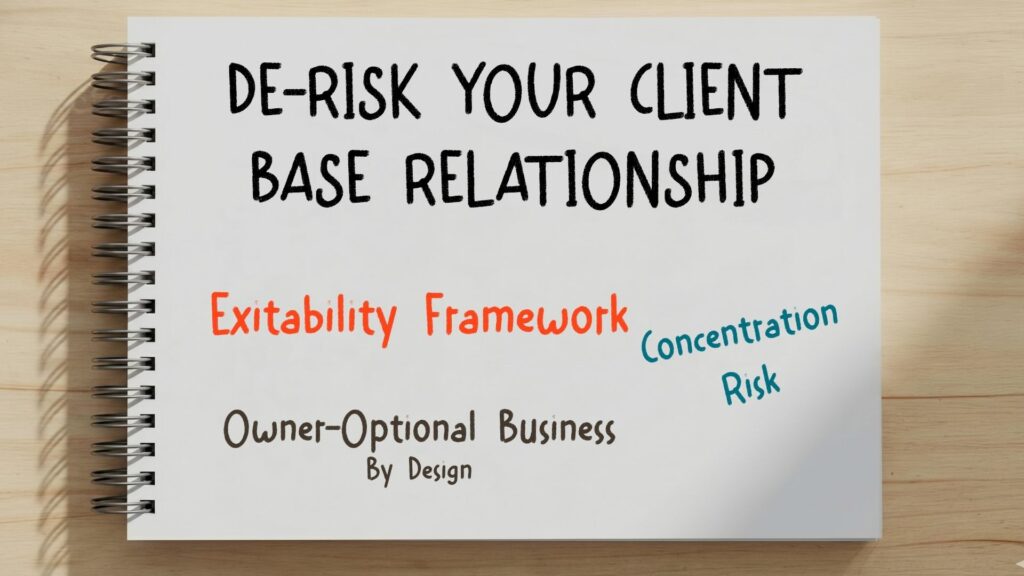
In the Exitability Framework, this is called Concentration Risk. It’s one of the most common structural vulnerabilities in family businesses, and it’s one of the most expensive. Revenue that is tied to a rep’s personal network rather than a documented, repeatable sales process creates what buyers call key-person risk. It means the business, as it currently operates, is not fully sellable. It’s partially sellable, with a significant discount applied to the part that depends on people who won’t necessarily stay after the sale.
The owners who feel this most sharply are the ones who assumed their strong revenue would translate directly into a strong valuation. It doesn’t, not automatically. A business turning over five million dollars with two reps holding the majority of client relationships in their heads is structurally very different from a business turning over the same amount with a documented sales process, a CRM that captures every client interaction, and a team trained to sell on value rather than familiarity.
The first business sells at a discount. The second sells at a premium.
The gap between those two outcomes is not a sales problem. It’s a structural one, and the time to address it is well before a buyer is sitting across the table asking questions you can’t answer.
What Value-Based Selling Actually Is
Before this gets filed away as more consultant theory, it’s worth being clear about what Value-Based Selling actually means in practice, particularly for a business where the sales team has spent years doing things a certain way.
It is not about abandoning the relationship. That would be counterproductive and frankly insulting to people who have built genuine trust with your clients over many years. The relationship is an asset. The goal is to make sure it doesn’t remain the only asset.
Value-Based Selling is, at its core, giving your sales team the tools and language to prove what your business delivers in terms a buying committee can act on. Not just “we’ve got a great product and the team is reliable.” That’s table stakes. What moves a committee is evidence. Measurable outcomes. Cost savings that can be calculated. Risk reduction that can be demonstrated. Efficiency gains that can be compared against what the client was doing before.
Your rep already knows this information intuitively. They’ve seen it play out across dozens of client accounts. What Value-Based Selling does is take that intuitive knowledge and make it explicit, documented, and transferable.
A simple example. Your rep knows that switching to your supply arrangement saved a particular client two days of administrative work per month. They’ve never written that down. They’ve never put a dollar figure on it. They’ve never turned it into a case study that could be used with a new prospect or presented to a procurement committee. It lives in their head, which means it lives nowhere useful when it matters most.
That shift, from intuitive to documented, from relationship-dependent to process-driven, is the practical heart of Value-Based Selling. And it is achievable without tearing apart what’s already working.
The Transition: How to Move a Long-Term Rep Without Breaking What Works
This is where most owners hesitate. They can see the logic of what needs to change, but the moment they picture that conversation with their senior rep, they back off. Nobody wants to tell someone who has given fifteen years of loyal service that the way they’ve always done things is no longer good enough.
That framing is the problem. The transition doesn’t need to be a performance conversation. It needs to be a capability conversation, and there’s a significant difference.
I’ve had this conversation more than once, and it’s never entirely comfortable. But the owners who have it early are the ones who don’t have to have a much harder conversation later, when a key client leaves and nobody can explain why.
One way to approach this is to position the shift not as a criticism of how the rep has been selling, but as a response to how the rep’s clients are now buying. The rep’s contact hasn’t changed. The environment around that contact has. Procurement is more involved. Committees are more common. Budgets are scrutinised more carefully. The rep’s job is the same, to protect and grow that relationship. The tools they need to do it have changed.
That reframe matters. It respects what the rep has built and gives them a reason to engage with the change rather than resist it.
Here are five practical shifts that move a sales team from relationship-dependent to value-capable, without dismantling the relationship capital already in place.
Start with the questions, not the pitch. Train your team to open client conversations with outcome-focused questions before moving to product or service discussions. What is the client trying to achieve this quarter? What’s causing them the most frustration operationally? What would a good result look like for them? These are not complicated questions. They’re the kind of questions a trusted advisor asks, and your rep already has the credibility to ask them. Most reps find this shift easier than they expected, because their clients actually want to have that conversation. They’ve just never been invited to.
Document what the rep already knows. Every senior rep carries years of client insight in their head. Margins they’ve protected. Problems they’ve solved. Savings they’ve generated. A structured debrief process, even a simple one, captures that knowledge and turns it into usable content. Case studies, outcome summaries, ROI references. This does not need to be a major project. It starts with one client and one documented outcome. In my experience, when you sit down with a rep and ask them to walk through their best client result from the past two years, they light up. They’ve never been asked to tell that story in a way that benefits the business. It takes an hour. The output is worth considerably more.
Build a proposal template that travels without the rep. When a buying decision goes to a committee, your rep is rarely in that meeting. The proposal they leave behind does the selling. That proposal needs to speak the language of the people in the room, finance, operations, procurement, not just the language of the rep’s main contact. A one-page ROI summary, a clear statement of business outcomes, a short comparison against the status quo. These are the tools that keep a deal moving when the rep isn’t present.
Introduce the CRM as a client protection tool, not a monitoring tool. Long-term reps often resist CRM systems because they feel like surveillance. The reframe is straightforward. Every client interaction that lives only in the rep’s memory is a risk to that client relationship. If the rep is sick, if they leave, if a client calls with an urgent issue and the rep is unavailable, the client’s history needs to be accessible. Documenting interactions protects the relationship. It also, not coincidentally, creates the kind of traceable sales process a buyer finds reassuring. One business owner I worked with described it this way: “I always thought the CRM was for the boss to check up on the team. Now I think of it as insurance for the client.” That shift in framing changed everything about how his team adopted it.
Let the rep lead the evidence gathering. Rather than presenting a new system and asking the team to adopt it, involve the senior reps in building it. Ask them to identify their three strongest client outcomes from the past two years and help you document them. People support what they help create. And the reps who have been around longest are often sitting on the best evidence your business has.
None of these shifts require a wholesale overhaul of how your team operates. They are incremental, and the best place to start is with the rep who is most open, not the one who is most resistant.
What This Means for Your Exit
Here is where the sales conversation and the exit conversation become the same conversation.
A business with a documented, value-based sales process is structurally different from one where the sales function depends on individual relationships and institutional memory. Not just operationally. In terms of what a buyer will pay.
When a buyer looks at your business, they are assessing risk. Every element of your operation that relies on a specific person rather than a documented system is a risk they will price against you. Your rep’s relationships, your own relationships with key clients, the knowledge that lives in people’s heads rather than your systems. These are the things that drive a valuation discount. And it is worth being honest here: in most family businesses, the owner’s own client relationships carry as much concentration risk as any rep’s. If your name is the reason three of your top ten clients stay, that is not a compliment from a buyer’s perspective. It is a liability, and they will price it accordingly.
Owner-dependent businesses with high key-person risk typically trade at 3x to 4x EBITDA. Businesses with documented, repeatable processes can command 6x to 8x EBITDA. On a business generating $1M EBITDA, that gap is between $2M and $4M in sale price.
The transition to Value-Based Selling is not just a sales improvement project. It is a valuation improvement project. Every client outcome you document is evidence that your business delivers repeatable value. Every proposal template you build is proof that your sales process exists beyond any individual rep. Every CRM record that captures a client relationship means one less thing a buyer can point to as a risk.
The business you are building toward, one that runs on process rather than personality, is the business that gives you options at exit. The ability to hold out for the right buyer. The ability to negotiate from a position of demonstrated value rather than projected potential. The ability to exit on your terms rather than someone else’s timeline.
It starts with a fifteen-year rep and a question worth asking now: if he retired tomorrow, what would stay, and what would leave with him?
The answer to that question is worth more than most owners realise.