

Get the business running without you.
Then decide what happens next.
Exit and Succession planning for SE Queensland and Nth NSW family business owners who are the load-bearing wall of the business and want to shift the load and burden of running a business.
Over three months I find where the business depends on you and work on shifting the load. Then I work with you and your team so the structure holds.
Fifteen minutes. You get your score – The three areas to work on first – Tools to start with and get the job done.
- A three month plan
- Practical not Theory
- Paid for the work, never for sale
Does this sound like your week?
Your foreman rings you whilst you’re at lunch. The bigger customers only want to deal with you and nobody else. Quotes sit on your desk until you get to them. Your three week holiday keeps getting interupted with emails. You’re not looking forward to what’s waiting for you when you get back to work.
This describes a bad week. For some a health scare, their own or someone they love, is their worst fear.
Others just wonder where they will find the energy for another five years of growth.
These are all situations that are kept private becuase the business needs the owner to carry on and show up every day.
You didn’t plan it this way. You started the business on your own and without a management team, and you just kept growing, and that became the operations.
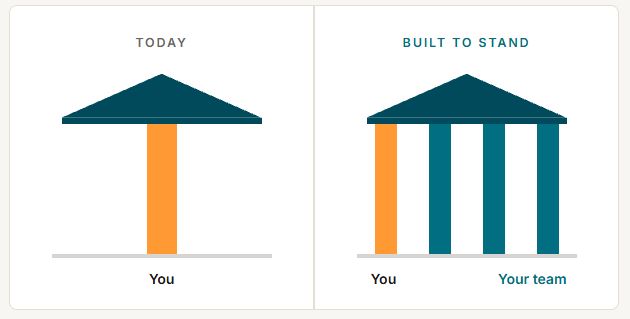
You’ve become the load-bearing wall.
This is typical when a business is built by a hands-on owner. A buyer or a successor will question the logic and ask why.
Most management solutions are written for bigger businesses.
What is assumed when solving problems for smaller businesses with management theory is there are resources in place. Like a Board or a HR Department with people and capacity to carry out the plan. In a medium sized business with 20 to 30 staff, the resources needed to implement the theory don’t match the actual resources. The result is the plan stalls, lands back on the owners desk and stays there.
Succession plans are often worst because it starts in the wrong place. The plan works towards a sale, the only possible outcome. The sequence assumes the a sale is the only possible option left to exit. What about the owner who isn’t ready to decide. What are their options?
Exit planners and Succession planers focus on the transaction and plan for a transfer.
I start with “getting the business ready for sale so you don’t have to.” A business that can run operationally without you in it, is worth more, gives you back time, and gives you the ability to plan your exit on your terms.
The value multiple changed based on the owner’s role.
OWNDER-DEPENDENT
2 to 4 times earnings
An owner-dependent business. Customers, decisions and know-how sit with one person. A buyer now prices in key-person risk and often asks you to stay on after the sale.
OWNDER-DEPENDENT
6 to 8 times earnings
An owner-independent business. There is a clear decision matrix, the processes are written down, and the team can show a buyer it runs without you.
Multiples of EBITDA. The ranges vary based on many industry factors and are indicative only.
Three steps over three months, then we rinse and repeat.
1
Find where the business depends on you.
We start with an Exitability Index assessment to see what’s working well, what could be leveraged, and which decisions, customers and knowledge sit only with you.
2
Decide what changes first.
Some things can move to your team quickly. Others need more time so people can be trained or systems put in place. Most advisors hand you a template and some instructions and see you in a month.
I’m a fractional manager who works with you and your team so the work gets done.
I keep a stocked toolbox, the Modular Operational Tool Vault. The point is to use the tools your business needs right now to match your capabilities and capacity, not to meet the needs of a cookie-cutter approach
3
Focus on the handover.
Who takes on what, by when, and what support they need for the handover to be sustainable.
We look at what worked, what needs to happen next to shift the load-bearing wall further off your shoulders. I stay on as your second in command (2IC), working in the business alongside you until your team is carrying the load.
There are no locked in contracts and you can stop the program at any time. The goal is to promote from within or employ a full time 2IC so I’m no longer needed.
Your team is trained to carry more of the load.
Buyers and successors look closely at the senior people in the business. Your supervisors will no doubt be good at their job. The challenge is to get them into a position where they are confident to run independently of you. I work with them so you feel confident they can deliver on that promise.
They become the pillars that spread the load so no one wall is a point of failure. A buyer wants to see a sound foundational structure so they can also feel confident on their day one as the owner.
Sell it, hand it on, step back, or keep it and enjoy it.
You don’t have to know which one yet. All four have the same foundation. A business that can run without you there every day. So that’s where we start. The decision stays with you, and you can make it On Your Terms.
Sell
A trade sale where the buyer pays for a business that doesn’t need you to run it.
Hand it on
To your team or your family. There are options for staff to buy-in over time.
Step back and draw a dividend
Stay on as the Managing Director, draw an income while working on the strategy and what you’re good at and love to do.
Keep it
Hold it as a portfolio asset and take on the role of Non-Executive Director and draw a dividend whilst the business runs without you, and enjoy it.
Whichever you choose, the first thing you get back is your time. The second is enjoying the business again. The higher sale value is an intended consequence when you are ready.
Find out where the business depends on you.
Most owners have a feeling the business needs them more than they’d like. The Exitability Index shows where that dependency sits and what it’s costing you. It scores eight dimensions, so you can see where the business is strong and where your presence is a potential load bearing risk.
Fifteen minutes. You get your score, the three areas to work on first, and the tool to start with.
01
Emotional Acceptance
Your readiness to let the business run without you at the centre.
02
Second-in-Command
Whether the people beneath you can carry real weight and be trusted to.
03
Financial Position
The strength and sophistication of the numbers underneath it all.
04
Founder Lane and Purpose
Whether your role is defined, or you are still doing everything.
05
Risk and Decision Style
How decisions get made, and how much of that still runs through you.
06
Relational Capital
Whether staff, suppliers and customers are tied to the business or to you.
07
Systems and Process
How much of the business lives in a system, and how much lives in your head.
08
Work and Life Stability
Whether you can step away, have time off sick, or take a week off without it costing you.
It takes less than 15 minutes to complete. You get your initial score -The three areas to work on first – The tools to start with.
Who I work with
I work with owners of businesses that have a physical presence, typically manufacturing, wholesale, logistics and trade businesses in South East Queensland and Northern NSW. Because of my fractional manager model I can only work with 2 or 3 clients at a time.
I spend real time working in each business.
This is for you if:
• You own a family business with 15 or more staff.
• You’re the hub. Decisions, key customers and problem-solving still come to you.
• You have supervisors, not a general manager, and you’re not ready to hire one (yet).
• You want to keep control without needing to be controlling.
• You’re thinking about your options over the next three to five years, even if you keep that to yourself.
This isn't the right fit if:
• You want to sell next quarter.
• You want a quick fix, or a generic framework with five steps to success. There are plenty of ‘gurus’ who will provide that.
• You’d rather do it on your own. The free resources on this site are a good place to start.
We may or may not be a fit.
If it looks like we are not a fit, I will tell you and I’ll usually be able to point you to someone I trust or give you resources to use on your own.
If we are a fit, I will do everything in my power to help get you to your goals. I have a reputation for being brutally honest which is why many of my past clients are still friends.
How I'm paid
I charge for the work I do in your business. It’s an agreed amount, over an agreed timeframe, with an agreed outcome.
I work in 3 month blocks, one month at a time.
What I don’t get paid for
My fee is not connected to a commission or referral payment based on the business sale or increased profit.
What I can and can’t promise
I can’t guarantee a sale price, a quick result, or that every person in your team will step up.
I can promise to tell you where the business really stands, and to be in there working with you while it changes.
What about your accountant, financial planner and lawyer?
I work alongside your professional advisers so any improvements or structural changes are communicated clearly to them.
I don’t get involved in tax, legal structures, superannuation or financial planning or any other personal advice.
I am bound by privacy laws and everything we discuss stays confidential.
You don't have to know which one yet. All four have the same foundation. A business that can run without you there every day. So that's where we start. The decision stays with you, and you can make it On Your Terms.
Whichever you choose, the first thing you get back is your time. The second is enjoying the business again. The higher sale value is an intended consequence when you are ready.

About Steve
I started my working life as an electrician, ran my own electrical contracting business at 22. I moved into sales in Programmable Controllers and Industrial Electronics. I then pivoted into financial services for 15 years, and then running my own financial services business.One more pivot into Human Resources spending 10 years in PNG.
After years advising large organisations on improving their people, processes and profits, I returned to Australia and developed a solution that used the big business theory and adapted it to a practical solution from family owned businesses.
Inspiring Business was born as a result of the 2019 pandemic and has allowed me to combine all my wisdom and knowledge to help family business owner bring joy back to their lives.
Clients call me their Unreasonable Friend because I’ll tell them what others won’t, and then work on a solution to fix it.
More about Steve →
Steve made a huge difference to our operations.
Andrew Scott
Managing Director, Scott Free Aust
More Testimonials here
It was a gentle and guiding process to understand what we had
Tori van den Donk & Karen Lindsay
Partner, Aegis Business Services
More Testimonials here
It drew out things that we had just not given enough thought to
Jeannette Jifkins
Director & Commercial Lawyer. Onyx Legal
More Testimonials here
Talk it through
An hour at your place. By the end you’ll have a clear idea
of where the business depends on you most,
and most importantly what to do next.
Not ready to talk? Take the Exitability Index first.
0421 998 822