


There’s a particular kind of research report that lands differently depending on where you are in your business journey.
A Key Person Risk report commissioned to examine what happens to Australian family businesses when a critical person leaves or becomes unavailable covers a lot of ground. Operational disruption, succession gaps, cultural erosion, knowledge concentration.
The finding that stands out isn’t the statistics, though they’re worth knowing. It’s the underlying irony the research keeps circling without quite saying out loud.
The key person most family business owners are worried about isn’t a senior employee. It’s not a star salesperson or a technical specialist.
It’s the owner.
And if your exit strategy doesn’t account for that, it’s not really a strategy.
The Irony Hidden in Plain Sight
Here’s what the research actually found.
In established Australian family businesses, the critical risks cluster around a very specific pattern. Critical knowledge sits with one person. Day-to-day decisions funnel through one person. Key client relationships are managed by one person. The strategic direction is held in one person’s head.
That one person, in most cases, is the business owner.
It shows up in small ways before it shows up in big ones. The four-week break that turns into daily check-ins by week two, not because anything has gone wrong, but because there’s a low hum of uncertainty that’s hard to switch off. The queue of decisions sitting on the desk on the first day back. The client who wanted to speak to you specifically. The supplier issue that nobody felt comfortable resolving without your sign-off.
The business kept moving. But it didn’t run. Not really.
Which creates a problem that most exit conversations never properly address.
A buyer evaluating your business isn’t just looking at revenue and profit margins. They’re looking at what happens to the business when the current owner walks out the door. If the honest answer is “significant disruption,” that gets priced into the offer. Sometimes dramatically.
Research from William Buck puts it plainly: operational dependency on key individuals acts as a direct red flag for potential investors, leading to lower valuations, more complex deal structures, or in some cases, making the business difficult to sell at all.
The business you’ve spent years building may be worth less precisely because you’ve been so central to it.
That’s the irony worth sitting with.
What “Key Person Risk” Actually Means Beyond Insurance
Most accountants, when they talk about key person risk, are talking about insurance. A policy that pays out if something happens to a critical individual. It’s a legitimate product. It’s also not what this article is about.
The deeper category of key person risk is operational, strategic, and relational. It’s the kind that shows up in a due diligence process. The kind that quietly reduces your negotiating position before you’ve even sat down at the table.
There are four areas where it tends to concentrate.
Knowledge concentration. Years of experience, process understanding, and industry insight that exist in your head rather than in any documented system. The research describes this as “tacit knowledge,” and it’s notoriously difficult to transfer. Standard operating procedures capture some of it. The intuitive problem-solving built over a decade of running the business? That’s harder. It’s the kind of knowing that comes from having seen the same problem twenty different ways and developed a feel for which solution fits which situation. That doesn’t transfer through a manual.
Operational dependency. The situation where you are the approval point, the decision maker, the person staff come to when something falls outside normal parameters. This isn’t just a risk for a future buyer. It’s a constraint on the business right now, limiting its capacity to operate independently of your bandwidth. A business that can’t make decisions without the owner present isn’t a business. It’s a very expensive job.
Relationship concentration. Key clients who deal primarily with you. Supplier relationships that exist because of your history with them. A bank that lends partly on the basis of their confidence in you personally. These relationships have genuine value. They also represent risk if they’re tied to an individual rather than embedded in the organisation. When the individual leaves, so might the relationship.
Succession under-preparedness. The Grant Thornton Family Business Survey found that 81% of Australian family business owners over 55 consider succession planning very or extremely important. Which sounds encouraging until you note that 15% still have no plan in place, and many of those who do have a plan haven’t moved past the formulation stage.
Awareness of a problem and action on a problem are different things.
This Happens in Good Businesses
There’s a temptation to read the above and assume it describes businesses with management problems. It doesn’t.
This pattern is most common in successful businesses. The kind where the owner’s judgment, relationships, and presence have genuinely been the engine of growth for ten or fifteen years. The centralisation happened because it worked.
I’ll be honest about something. In almost every business I’ve worked with at this stage, the owner already knows this on some level. The check-ins during holidays, the decisions that pile up while they’re away, the staff who are capable but somehow never quite confident enough to make the final call. These aren’t surprises. They’re familiar. What’s missing isn’t awareness, it’s a clear path for doing something about it without destabilising the business in the process.
The research makes an observation worth pausing on. The very characteristics that made the business successful, agility from concentrated decision-making, strong client relationships held personally, a culture built around the owner’s values and presence, are the same characteristics that create valuation risk at exit.
Past success and exit readiness aren’t the same thing.
This isn’t a criticism of how the business was built. It’s an observation about what needs to change if the exit is going to deliver what the owner is expecting, for themselves and for their family.
The Twelve-Month Question
There’s a question that’s useful to apply to your own business, honestly.
If you stepped away completely for twelve months, what would actually happen?
Not the optimistic version. The realistic one.
Which decisions would stall because no one has the authority or the judgment to make them? Which clients would start asking where you are? Which processes would produce inconsistent results because the “how” lives in your head rather than in a documented system?
The gaps in that answer are, broadly speaking, the gaps that show up in a buyer’s due diligence.
One approach that makes sense for businesses at this stage is to treat this exercise not as a criticism but as a design brief. The question isn’t “why haven’t I fixed this already?” The question is “what would need to be true for this business to run effectively without me at the centre?”
That’s a different problem with a workable answer.
What an Optional-Owner Operation Actually Looks Like
The term “optional-owner operation” gets used loosely. It’s worth being specific about what it means in practice for a family business at this stage.
It doesn’t mean the owner is absent or disengaged. It means the owner’s presence is a choice rather than a requirement. The business has the systems, the people, and the documented processes to function at a high level without constant owner input. The owner contributes at the level they choose, focused on the areas where they add the most value, rather than being the bottleneck for everything that moves through the business.
Getting there typically involves work across four areas.
The first is knowledge transfer. Critical processes need to exist in documented form, not just in memory. This goes beyond writing a procedures manual. It involves identifying the decisions that currently sit with the owner and systematically building the capacity for others to make those decisions well. That’s partly documentation and partly deliberate development of the people around the owner.
The second is leadership depth. Most family businesses at this stage have capable people in operational roles. What they often lack is people who are genuinely equipped to lead. Building a second tier of leadership, people who can make judgment calls, manage staff, and represent the business to clients without the owner in the room, is the single most leveraged investment an owner can make in the three to five years before exit.
The third is relationship institutionalisation. Key client and supplier relationships need to be progressively shifted from the owner to the organisation. That means introducing other team members into those relationships early, ensuring clients have multiple points of contact, and making sure the business, rather than the individual, is the entity those relationships are anchored to.
The fourth is governance clarity. Decisions need a home that isn’t the owner. That means clear role definitions, documented authority levels, and a framework that tells people what they can decide independently and what requires escalation. Not bureaucracy. Clarity.
None of these are particularly complicated in isolation. The challenge is doing them sequentially and methodically in a business that still needs to operate while the work is happening.
The Valuation Connection
The reason this matters isn’t abstract.
A business that runs effectively without the owner at the centre is worth more than an equivalent business that doesn’t. Research cites evidence that businesses where owners maintain appropriate distance, where the team and systems handle client interaction rather than the owner personally, consistently achieve higher valuations. The logic is straightforward: a buyer is paying for a business, not for access to a particular person. The more the business functions as a system rather than an extension of an individual, the more transferable, and therefore more valuable, it is.
The Silver Tsunami dynamic makes this more urgent, not less. The wave of baby boomer and early Generation X business owners coming to market over the next few years is going to create real pressure on valuations across affected industries. Supply of businesses for sale will increase. Demand won’t keep pace. In that environment, businesses that are demonstrably owner-independent are going to be considerably better positioned than those that aren’t.
A buyer choosing between two comparable businesses, one where the owner is the business and one where the business runs as a system, will pay a premium for the second. In a crowded market, that premium could be the difference between the exit the owner planned and the exit they have to accept.
The window to work on this is now, not in the twelve months before you want to sell.
A Practical Starting Point
If this resonates, the most useful next step isn’t a full strategic review. It’s an honest internal assessment of where the dependencies actually sit.
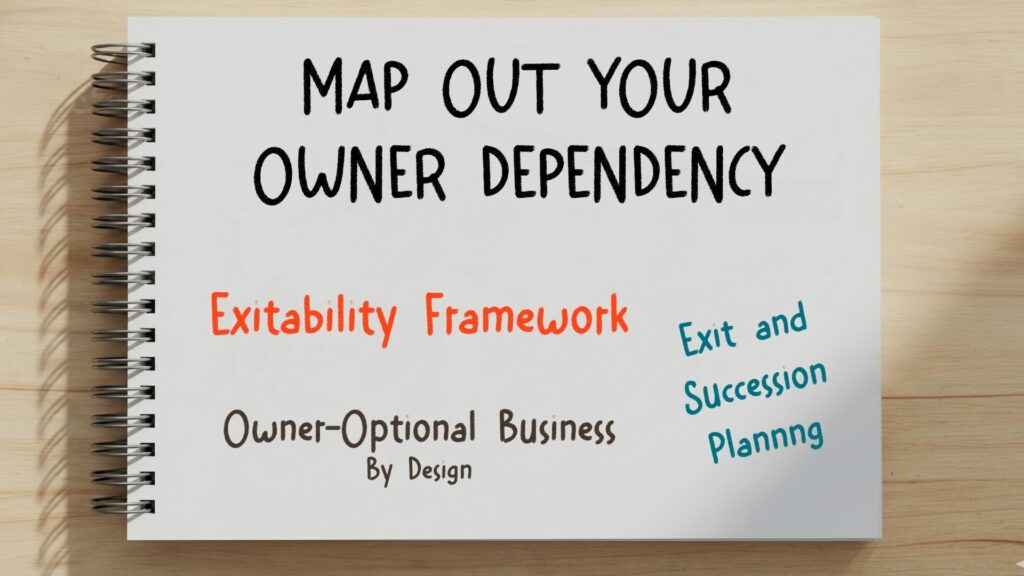
Map the decisions that only you can make. Map the relationships that exist primarily because of you. Map the knowledge that would be lost if you weren’t available. That gives you a clear picture of where the risk is concentrated and where the work needs to happen.
From there, it’s a question of sequencing. Which dependencies create the most valuation risk? Which are most practical to address first? What does a realistic twelve-month plan to reduce the critical ones actually look like?
These are questions worth working through carefully, ideally with someone who can provide an honest external perspective rather than the reassurance that everything is fine.
The goal isn’t a business you want to leave. It’s a business you don’t have to stay.
If you’re a family business owner thinking about your exit in the next three to five years, I work with a small number of clients at a time on exactly this kind of transition. Start with a conversation. No obligation, no sales process. Just an honest look at where your business sits and what the path forward might look like.
Connect with me on LinkedIn or visit inspiringbusiness.net to find out more.