


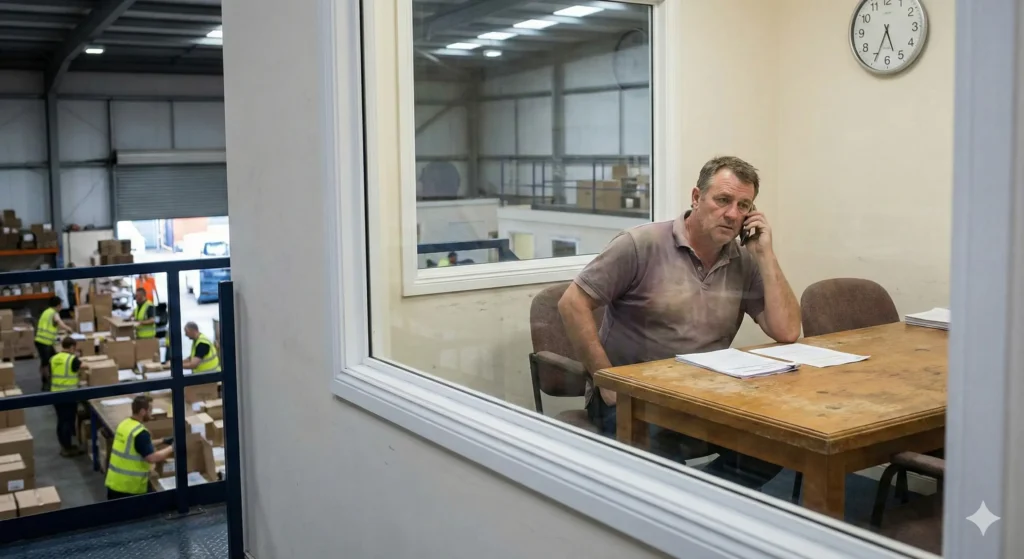
The call came mid-morning. His sister. There was a health issue in the family. Serious, the kind that doesn’t resolve in a week. He was needed, not at the business, but there. Permanently, for the time being.
He told me about it a year later, in one of those calls that starts with “how are you going” and turns into something else. What surprised me was his tone. Not relief, exactly. But a steadiness I hadn’t expected.
The business was fine.
Not limping along, not barely holding together. Fine. His team was running it. His key clients were being looked after. The decisions that needed to be made were being made. He’d built something that didn’t need him in the building every day. That’s not the outcome for most owners in that situation. Not by a long way.
The Business That Lives in Your Head
Most businesses at the $3M to $5M mark are built around the owner. That’s not a criticism. It’s how you get to $3M to $5M. You outwork everyone, you know every client, you know which supplier to call when the regular one can’t deliver, you know the workarounds on the warehouse floor because you built half of them yourself.
That knowledge is the business. And it lives entirely in your head.
When you’re there, everything works. When you’re not, the gaps start to show. The road rep quotes at the wrong margin because he’s used to checking with you first. The warehouse manager handles the routine but defers on anything outside the usual. The office calls your mobile because that’s always been the fastest way to get an answer.
None of this is a crisis when you’re on holidays for two weeks. It becomes one when the absence isn’t short and isn’t planned.
I’ve worked with enough business owners to know the conversation that doesn’t happen. The one about what the business actually looks like when you’re not in it. Not the financials. The operational reality. Who makes decisions when you’re gone? Not in theory. In practice, on a Tuesday afternoon when something goes sideways and you’re not reachable.
Most owners, if they’re honest, don’t know the answer. They’ve never tested it. The business has never had to run without them for long enough to find out.
What Building the Infrastructure Actually Looks Like
My client had tested it. Not by accident. We’d spent the better part of a year building the infrastructure before he needed it. Decision frameworks for his managers. Documented processes for the operational workarounds that had existed for a decade only in the heads of the people who’d invented them. A sales process that didn’t depend entirely on the relationships his rep had built over 20 years on the road.
When the call came, the business was ready. Not because he’d planned for a health crisis. Because he’d done the work anyway.
The Gap the Advisory Industry Won’t Close
Every exit planning conversation in Australia starts in the same place. When do you want to leave? What do you think it’s worth? Are the books clean? Have you talked to your accountant about the small business CGT concessions?
These are legitimate questions. They’re also completely secondary.
Your accountant is thinking about this year’s tax and the transaction he’ll handle when you sell. Your financial planner is thinking about the proceeds he’ll manage once they land in your SMSF. Your broker will start thinking about you the moment you’re ready to list. All of them are focused on timing and transaction. Not one of them is incentivised to spend three years helping you build a business that runs without you.
That’s the gap. And it’s not a small one.
Forty-eight per cent of Boomer business owners in Australia plan to exit within five years. Only 24 per cent have a succession plan in place. The rest are going to negotiate with the market from whatever position they’re in when they decide to leave, or when life makes that decision for them.
Buyers know this. A buyer walking into a $4M manufacturing business where everything runs through the owner isn’t buying a business. He’s buying himself a new job. And he’ll price it accordingly.
Operational Independence Is the Work
Building operational independence isn’t a nice-to-have on the way to the exit conversation. It’s the work that makes the exit possible on your terms, not on someone else’s. It’s also the thing that protects you if the timeline stops being yours to control.
My client didn’t get a better outcome because he had a good exit plan. He got a better outcome because the business could function without him before he needed it to. There is a difference. And the advisory industry isn’t set up to help you close that gap, because building infrastructure isn’t how most advisors get paid.
Here’s the question worth sitting with.
If the phone rang tomorrow and something took you out of the business for six months, what would actually happen?
Not what should happen. Not what you hoped would happen. What would actually happen, on Monday morning, when staff arrived and you weren’t there?
Would the decisions get made? Would the key clients be looked after properly? Would the road rep know how to quote and follow through without calling your mobile?
If the honest answer is “I’m not sure,” that’s not a planning failure. That’s where most owners are. But it’s also the gap between a business that holds through a crisis and one that doesn’t. And between a business that sells on your terms and one that sells on the buyer’s.