
The Succession Plan That Keeps Being Put Off
The concept of planning is not lost on most Family Business Owners. End of Financial Year, end of calendar year. Planning to roll out a new product or office. It’s a common activity with I would say a high proportion of small and medium sized businesses.
Why is that eighty-one per cent of Australian family businesses have not started on documenting their succession plan?
You’ve no doubt heard of this many times and you may even be in this group. One explanation of the reluctance to start is owner-denial also known as succession fatigue.
The hypothesis is that owners can’t reconcile their retirement with their current situation. The easier option is to leave it until there is more time to think about it, and this leads to a hard stop as the time runs out and it’stoo late.
However, it’s also a convenient narrative that is used by people selling succession plans because it’s what has been trotted out for decades.
Exit plans often stay unwritten because the template positions a date rather than reason.
Pick a date. Name a successor. Sign the document. All of that assumes two things are already in place: a business that runs without you, and a next-generation leader who can take over. As the data suggests only a few family businesses have this owner-optional structure. They are more owner-dependent, so the template goes in the drawer, and the drawer stays shut.
Why the plan stays in the drawer
The Australian statistics indicate only nineteen per cent of family businesses have a documented succession plan (GTAL National Family Business Report 2025). A third have no plan at all (KPMG Australia Family Business Survey 2025). In the same research, succession came out as the number one challenge in the sector, ahead of cash flow and competition.
The age profile of successors is where it gets pointed. Almost a third of the successors (and increasingly buyers) waiting to take over are aged in their mid forties and early fifties.
On the employee or family side, they are experienced, capable, ready to lead, and still waiting for the baton. Many are watching the years go by while the founder can’t find the moment to step back.
On the buyer’s side, the next-generation are not interested in a business as a job, they are looking for a role that will fulfill their financial and emotional satisfaction. And if that sounds like a bunch of new age words then the process of selling will be interesting.
The label that is applied to the concept of waiting is Succession Fatigue. The state of knowing the work needs doing, having known for years, and putting it off because starting the plan makes the ending feel real. The cause is an emotional weight that needs context. It’s the strain of decoupling the owner’s personal value from the business value. It’s not easy to let go of the business as an extension of who you are after decades of being just that. But without an Optional Mindset, a way of staying in control and being less controlling, fatigue turns a manageable five-year transition into a six-month scramble.
Why you can't just hire the problem away
The obvious workaround is to bring in a general manager or an external leader and let them carry it. Reasonable idea. The market has other plans.
In 2026, leadership and management are the hardest skills to hire. More than half of Australian employers currently recruiting say so, with leadership and management topping the list at 51 per cent, ahead of AI and data talent at 45 per cent (2026 Workplace Trends Report; global workforce data). The capable operator who can run your business the way it needs to run, at a wage you’d actually afford, in your region, is not sitting waiting for your call.
Which leaves one real option. That leadership has to be built inside the business, from the people already in it. That’s slower than hiring, but it’s also more sustainable because a leader grown inside the business has a deeper understanding of the culture, customers and the trade in a way that enables an organic owner-optional framework.
From exit to evolution
The word doing the damage is “exit.” It frames the whole thing in the owner’s mind as a door to walk out of, one day, for good. No wonder founders freeze. You built this. Your professional standing, your income, your family’s security, your place in the community all run through it.
“Exit” asks you to picture the day you become irrelevant to the thing that made you.
Evolution asks a different question. Can the business operate without you being the load-bearing wall? That question points at the business getting stronger rather than at you walking away, and it holds true whether you step back at fifty-five or eighty-five or never.
This is the work I call Exitability. A business is exitable when it runs independently of the owner, and the capacity to leave is itself the asset, whether or not you ever use it.
Build for Exitability and you buy yourself options you don’t have today.
Building a business that runs without you
Plenty of advisers will tell you the fix is to “let go of control.” Ignore them. Why would you abdicate control over one of the largest assets you own?
Control and controlling behaviour are two different things. You can keep full visibility of the business while stepping out of the daily decisions. The mechanism is the point. Put the right reporting and standards in place and you get the information without having to be in the room. That’s a control mechanism doing the work, without the controlling culture.
The other half is your people. Delegation doesn’t work as a memo. It works when you’ve made enough Trust Bank Deposits with your key people, taken the time to understand them and give them what they need to do the job, that handing over a decision no longer costs you sleepless nights.
This is where the rising-generation leader gets built. Not by title. By capability and demonstrated trust, deposit by deposit, over eighteen months to three years of deliberate work.
That timeframe needs to be realistic, and it’s working time rather than thinking time: building decision frameworks, documenting how the work gets done and developing the people until the business can prove to a buyer, a successor or your own bank account that it runs without the founder.
What the evolution is actually worth
The commercial case is in the figures. A business that depends on the owner as the central nervous system sells for two to four times EBITDA, if it sells at all. A business with documented systems and distributed decision-making sells for six to eight times. Same revenue. Same trade. The gap is owner-dependency, and it’s the difference between a comfortable exit and a disappointing one.
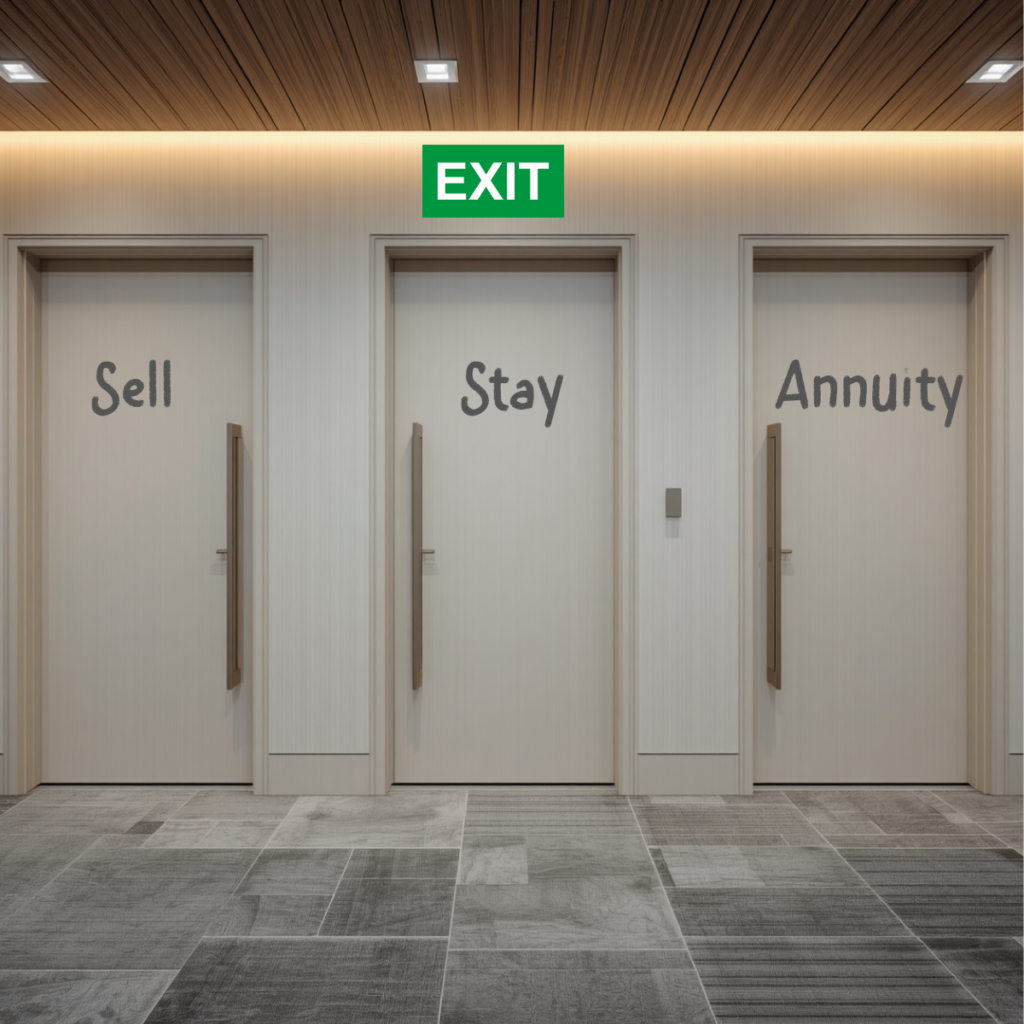
Owner-independence doesn’t only lift the price. It creates choice. Once the business runs without you, three doors open, and you pick.
You can Sell, at the higher multiple, to a buyer who isn’t demanding you to stay on for three years and an escrow.
You can Stay, in a genuinely strategic role, working toward a week that’s seventy per cent strategy and thirty per cent operations instead of the reverse.
Or you can take a Dividend, stepping back to a non-executive position and drawing on the profits of an asset that runs itself. That last one has a name owners rarely hear from their advisers: retiring into your business, rather than out of it.
Three options. All of them built on the same underlying work. None of them require you to have picked a date first.
Where to start this week
Don’t start by writing the succession plan. The plan is what you produce at the end, not where you begin, and beginning there is exactly why it lands in the drawer.
Start with one honest question. What breaks if you’re unavailable for a month? Not a holiday where you’re checking your phone. Properly out. Write down what falls over, who calls you anyway and which decisions simply wait for you to come back. That list is your succession plan in reverse. Every item on it is a piece of the business that still runs through you, and each one is a place to make a deposit, build a system or grow a person.
That’s the work Inspiring Business does with owners. The Exitability Index tool finds where the dependency sits, the Owner-Optional design to engineer it out using the team you already have and a leadership program that closes the gap between you and the people who’ll run the place.
Built for a business with your resources, not a corporate one with a strategy department.
The plan can wait. The evolution starts the moment you’re honest about what breaks when you’re not there.
More information on the capability and capacity training we offer apply for the Professional Development Waitlist