


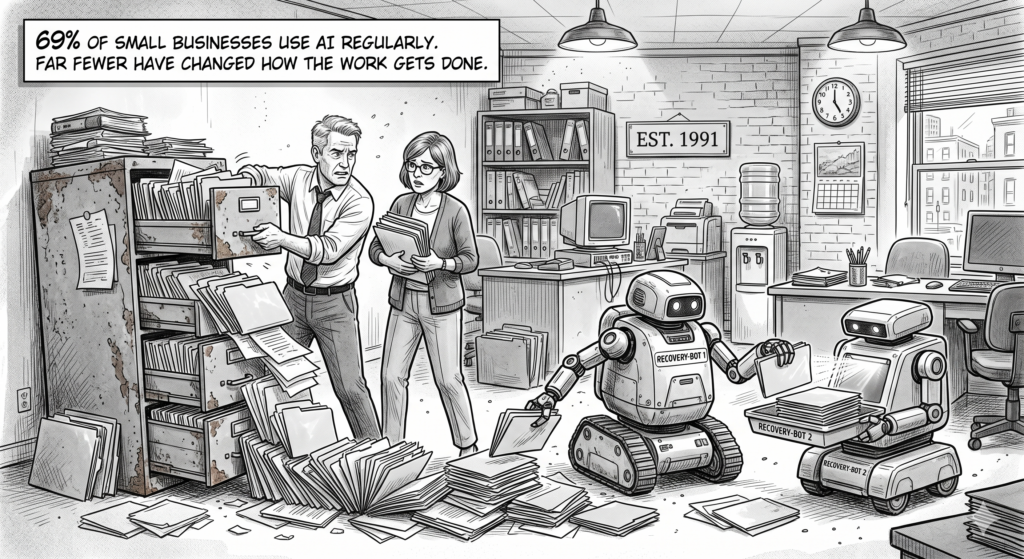
Most small businesses now use AI regularly, yet far fewer have changed how the work actually gets done, which is why the promised productivity boom keeps arriving as a faint improvement rather than a real one. The tools are everywhere. The rethink that makes them pay off is rare. That gap is the whole story.
What the numbers say
The National AI Centre reports that regular AI use among Australian small and medium businesses has reached 69%, up sharply from 40% in July 2024. Of those using it, 79% report productivity gains, well up from 37% in mid-2024. The adoption curve is steep and the experience is mostly positive: among users, around 43% reported higher revenues, roughly a quarter reported lower operating costs, and 19% linked AI to employment growth, against 6% who said staffing had fallen.
Sitting underneath those figures is the finding that matters most. Most businesses have bolted AI onto their existing processes without redesigning the underlying workflow. The result is shallower than the headline suggests: faster versions of the same tasks, rather than a different way of running the business.
What it means for you
There is a real difference between using AI and changing how your business works, and almost everyone is doing the first.
Using AI looks like drafting emails faster, summarising a document, writing a quote in half the time. Genuinely useful, and it explains why so many owners report a productivity bump. It also explains why the bump stays modest. You have made the existing tasks quicker without removing any of them, and the business still runs the way it always did, with you at the centre of it.
Changing how the work gets done is a different exercise. It starts with the jobs that only happen because you are there to do them: the quoting that waits for your eye, the scheduling that lives in your head, the supplier decisions nobody else is trusted to make. Redesigning those so the work flows without you is where AI stops being a faster typewriter and starts reducing how dependent the business is on the owner.
That distinction is not just about productivity. The single biggest factor in what a family business is worth, and how livable it is to run, is whether it can operate without the owner in every loop. A business that has used AI to remove owner-dependent steps is easier to run today and worth more to a buyer tomorrow. A business that has used AI to help the owner do more, faster, has quietly made the owner even harder to replace.
The tools are not the hard part anymore; 69% of your peers have already picked them up. The work is deciding which parts of the business should stop depending on you, and pointing the technology at those.
Sources:
National AI Centre — AI adoption insights: December 2025 to February 2026
SecurityBrief Australia — Australian SMEs adopt AI but lag on workflow change